How easy (or difficult) is it to be a vegetarian in Japan? When I was young and living there (many years ago now - all will be revealed at the end of the story!) it was easy because I cooked most of my own food at home, and there are many great vegetarian ingredients, like tofu, miso, seaweed, sesame seed products, vegetarian jellies etc. But eating out was limited in Japanese restaurants as fish stock is used everywhere, leaving me with usually one dish or one bowl of rice and pickles! Ethnic restaurant (i.e Italian, Indian etc.) often offer more possibilities, or at least the side vegetables don't have fish stock and you can order a plate of pasta, a salad or a curry. But although it is ok to go to ethnic restaurant if you live there (and the best Italian food outside Italy is in Japan, for sure!), when visiting for just a few days or weeks one probably hopes to eat real Japanese food!
This time we stayed two weeks, and the first week in Tokyo was easy as we stayed in an apartment closed to a good supermarket and shopping area, and we cooked most dinners. But for lunch we were always out and about, keen to try Japanese restaurants.
So what to eat? The first two dishes that come to mind are:
There are two places that stood out in our Tokyo trip, both chosen by Bence and Judit, who really like traditional Japanese cuisine. One is
Yagenbori, and for Vegetarians I suggest to order the yudofu and then request just soy sauce in the dipping bowl (no dipping sauce, which is made with bonito flakes). The other place is
Senba, for soba (they also make soba with walnuts). Soba restaurants are good but remember that the dipping sauce is, once again, made with fish stock. So I usually just asks for a bowl of hot water, then add all the trimmings that they give you (gated daikon, chopped spring onions...) and some soy sauce. As long as the soba itself is good quality, this sauce will suffice for me. And you can ask for a vegetable tempura to accompany your soba!
 |
| Yudofu at Yagenbori |
Sushi?
Then, if you have kids and you don't mind being in the same place where they handle fish, you should try to go to a Kaiten-zushi (conveyor belt sushi bar). Going to "serious" and expensive sushi bar is out of the question for me: it would greatly offend the sushi chef that you don't eat his (yes they seem to be all men) perfectly chosen and cut fish. Kaiten-zushi are cheaper and more relaxed, and some are really good. Of course it helps to know what to get: classic are Kappamaki (cucumber rolls, often with lots of wasabi), Kampyo (gourd ribbon rolls), Takuan (pickled daikon rolls), and Inari san (fried tofu parcels). The omelette rolls may have fish stock, so check first. Then there are many other offerings, depending on the season and shop. In spring you can find asparagus sushi, and in Autumn mushroom sushi. We got some with mini pickled eggplants (great idea that I will copy asap) and with other pickled vegetables and shiso leaves, but this was in Kyoto, a city famous for its delicious pickles. I need to mention that there is also
natto, but this is very much an acquired taste that I personally failed to acquire!
 |
| A kaiten-zushi in Kyoto |
Snack food, Pub food and Hotel food
The safest snacks in Japan for vegetarians and vegans are onigiri (rice balls). But these too can have a variety of fillings, so make sure to get the ones with ume (pickled plum) or kombu (seaweed). Sometimes you can find other types, with different seaweed fillings, and in traditional Japanese pubs (izakaya) they usually have yaki onigiri (plain rice but grilled and hot). In fact I have to say that in most izakaya vegetarian food is limited to these yaki onigiri, peanuts and edamame beans! Fortunately the beer is very good!
Japanese hotels usually serve breakfast and sometimes dinner, and you really need to let them know before that you are a vegetarian. Big hotels with buffet breakfast are ok, there is always something to eat because they often put out a spread of both Japanese and Western breakfasts (which sometimes includes things like chips and salad!), and larger hotels will also have Chinese and Korean food.
Dinner buffets are a bit more of a challenge: gone are the cereal, yogurt, toasts and fruit, and in are dishes loaded with meat or fish! But once again letting the cook know is always the best bet, because I know for experience that:
a really good cook is someone whose main concern is to feed others
Feed, not let them starve! We arrived late at our hotel in
Gifu and were the last to eat from the buffet, but even if it was still food most of the food wasn't vegetarian. I told the waiter, who told the chef, and the following evening the chef had prepared a spacial meal for us! They brought us 5 different dishes (below the photos of two, then I run out of battery), and it was really a lot of food: a hot pot with simmering tofu and vegetables accompanied by miso sauce (vegan), Vegetable tempura (vegetarian), Stir fried vegetables (vegan), steamed spinach with sesame (vegan), and a massive vegetable omelette (vegetarian). And of course we had rice and pickles and dessert... This is not the first time that this happens to me, in fact in most places if I let the chef know in advance he or she will prepare something special for me, and often put quite a bit of effort and creativity into it. And I remember well when I was the cook (and this is ... well over 22 years ago!) in a staff restaurant in London, and I cooked for people who ate meat, or where vegetarians, or didn't eat pork or beef, or had allergies, and I always managed to give everyone something to eat, because that was my job.

Vegetarian restaurants?
I was really looking forward to going to Kyoto to eat some traditional vegetarian cuisine. There is a Kyoto Vegetarian travel reportage here if you are interested, but this time we didn't eat in temples, but at Kanematsu - number 108 on the Nishiki map. It was by chance really that I found this 'boutique' restaurant, I was buying some yuba (tofu skin) in a tofu stall and I asked the owner if he knew a Vegetarian restaurant near by. Kanematsu is definitely something that I will recommend to friends like Bence and Judit (i.e. people that love authentic Japanese cuisine in a nice setting), and our friend Shin too was very impressed with my discovery! Kanematsu is on the second floor of a fruit and vegetables shop, (one of those that sell gift boxes containing 20 strawberries for 10,000 yen, and I would never have gone there otherwise!) and I need to advise you that it is not a vegetarian restaurant but a vegetable restaurant!! This means that the food is based on vegetables, but occasionally there may be a dish cooked with fish stock. Vegetarians are advised about this, and the dish can be replaced with another vegetarian dish. I particularly enjoyed the rice cooked with lily bulbs, and the baby taro tempura!

So glad for Japanese cakes!
I love wagashi, Japanese cakes. I also love all kind of cakes, and in Japan they make some amazing Western style cakes too, some so beautiful that they don't even look real. But in keeping with the Japanese cuisine theme of this post, I will talk only about Japanese style cakes. And sweets, of course, but to be honest I find the sweets more pretty to look at that to actually eat. Those below were an exception though, possibly because they looked like miniature wagashi.
 |
| Kyoto sweets |
It is good to try green tea in Kyoto, the real
Matcha tea (powdered tea whipped with a little tea whisk), and tea always comes with a wagashi. But wagashi can be bought in most places for a quick energy snack, they are not overly sweet, they are full of bean proteins, and they tend to be vegan.
 |
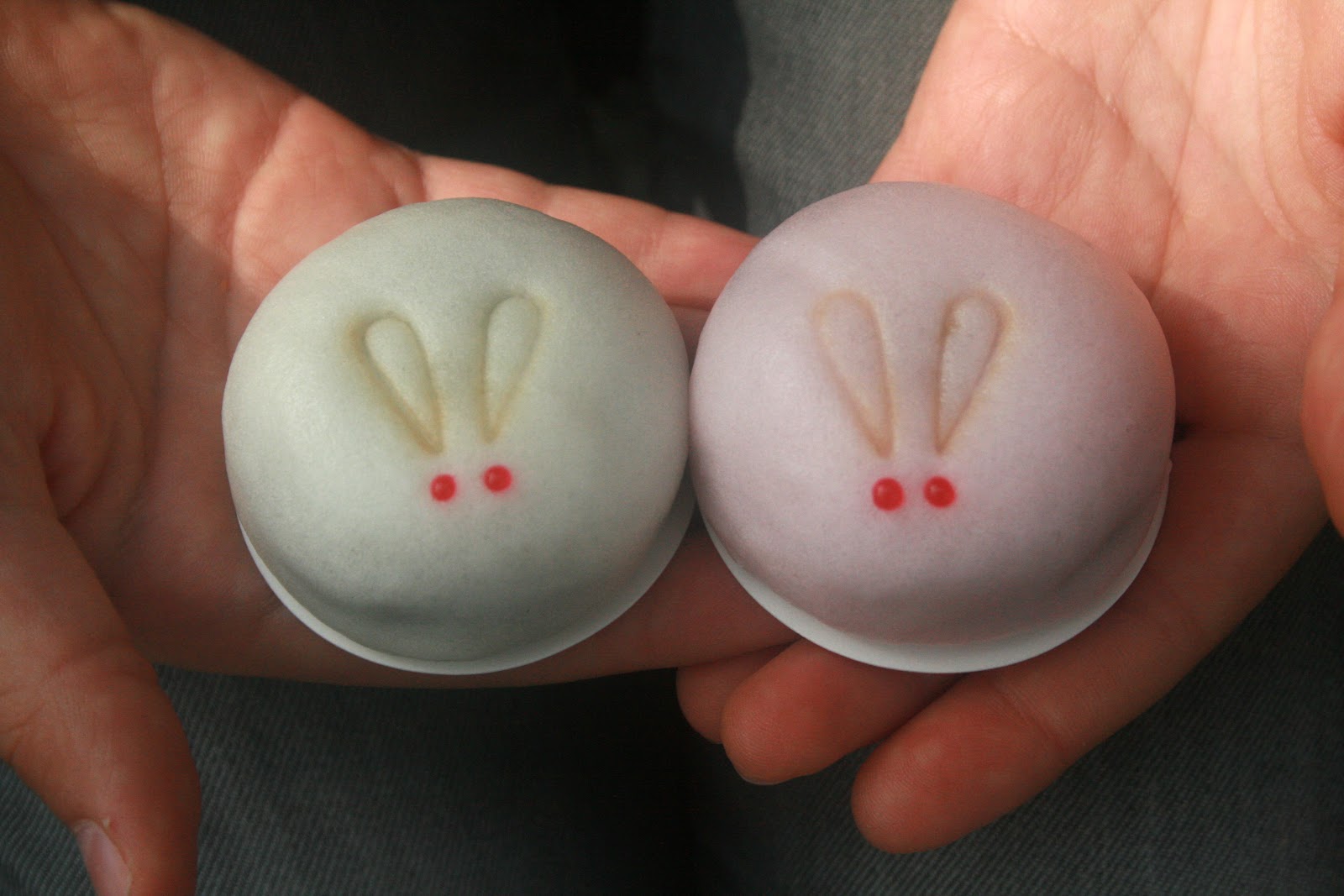
| Bean paste heaven! Clockwise from top left: Green tea and wagashi (glutinous rice cake filled with anko, bean paste); more rice and anko wagashi, shaped like rabbits; wafer case filled with anko and a whole candied chestnut: waffle style hot cakes filled with anko. |
We also have a friend whose parents own a sweet shop in Tokyo, and they alway give us cakes, like yokan, a bean 'brick" with the consistency of quince paste. I thought that yokan was made exclusively with beans, and then in Kyoto I tried one made with persimmon, and it was delicious! Other cakes are made with chestnuts or sweet potatoes, and then there several glutinous rice cakes, and
sembei, rice crackers (they are made in sweet shops in Japan, although no Westerner would think of them as sweet!).
 |
| Yokan, made with azuki (left) and persmmon and figs (right) |
Conclusion: there is a lot that a vegetarian can eat in Japan, but language can be a big barrier! I remember when I went to live there for the first time (20 years ago!), I had just arrived and I was struggling to get understood in a restaurant. I was sitting near a fish tank and I asked the exasperated waitress if I could have miso soup without fish (and pointed to the fish in the tank). A part from a bowl of plain rice I didn't managed to find anything without meat or fish on the menu, and the soup was my last chance. She returned smiling and saying 'here you are, mizu, and not fish in it!" and gave me a glass of water. Instead of ordering miso I asked for mizo, plain water! At least it had no fish swimming in it!!
Photos by Alessandra Zecchini ©


 And yes, we will be visiting again, maybe in Autumn next time? It was really cold, so for a laugh I am adding a photo in the bus with our friend Shin, I am all covered up and with a mask (a must in Japan if you are coughing and sneezing).