Tuesday, November 3, 2009

Beautiful Parma...and a few cities in the province of Reggio Emilia


Recently I visited Parma, and I thought that it was so beautiful that I had to return for a second visit after just a few weeks. I told a NZ friend about it, she was visiting Genova, and she took a day to go to Parma from there. She was also impressed, and thought that it was one of the most beautiful cities in Europe, and with very pleasant citizens!

Founded in Roman times, the city had its heyday during the Renaissance period. Many buildings constructed under the duchy of the Farnese family, including the Farnese Theatre and the Palazzo della Pilotta housing the “National Gallery of Parma” still dominate the city. The National Gallery displays masterpieces by Correggio, Parmigianino, Leonardo da Vinci and
El Greco.


The city is elegant, clean and beautiful without being over-rated.
And there aren't many tourists.


Parma is also a city of culture, art and music (Giuseppe Verdi, Ildebrando Pizzetti and

Impoverishing culture enriches ignorance


And Parma is a city of bicycles, bicycles everywhere, just wonderful!!!


I stopped for a non-alcoholic Mojito (based on fresh lime and mint) and the waiter brought to the table a vast array of free snacks (olives, crisps, focaccia, pizzette...); the French couple sitting next to me was impressed with all the free food "c'est beaucoup!"


I had my friend Luca as a guide for the Famous Teatro Farnese
(unfortunately we were not allowed to take photos)
and the Duomo Square


Antelami's octagonal pink marble Baptistery (above)

Inside the Cathedral (below)


I stayed in the beautiful Hotel Stendhal
in the heart of the city and near the Palazzo della Pilotta


My room...


... And the view from my window.


I also stayed with Luca's family, outside Parma (in Boretto, which technically is in the province of Reggio Emilia but it is close enough to Parma), so I had the chance to see also the surrounding small towns of Guastalla, Gualtieri, and Brescello, all gems!

But the most precious gem of all was Luca's mum! She cooked and she cooked like
only a donna emiliana can cook.

Here is the dough for gnocco fritto


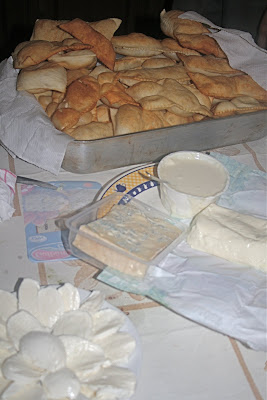
And here is the final product....


...with a variety of cheeses for the veggie guests.
My husband and the children looooooved this!


And thanks to Luca's family I also made a very important cheese discovery:


And then there was fresh pasta, made by hand of course...


and ravioli filled with spinach...


and home made sweet pastries with home made jam...

and home made gnocchi...


Thank you guys, I felt like a Pope!

Photos by Alessandra Zecchini ©


Sunday, November 1, 2009

SF School Gardens in Italy


In Italy I visited two of the school gardens of Slow Food Feltrino e Primiero with the Convivium coordinator Ornella Fadda. Five school garden have been created in the area, thanks to volunteers and to the local dairy, Latte Busche, who is sponsoring the project. Latte Busche is donating 2,500 Euros for three years (about NZ$5,000 per year).

The dairy distributes local milk and makes a varieties and cheeses, dairy products and ice creams.


Latte Busche most famous cheese is Formaggio Piave, made exclusively with milk from the Belluno area. This is one of my favourite cheeses!


And now to the Gardens:
I visited the gardens during the summer holidays, so I couldn't see the children and parents at work, but here, in the garden of the Vittorino da Feltre elementary school, in Feltre, I met with the school caretaker Gisella (in the photo), a keen gardener and the school staff members who teaches the children about gardening, and maintain the gardens throughout the year.

In the same school SF also planted an orchard, and I loved the palisades made with poles cut and painted like gigantic coloured pencils.

Then I visited the SF garden of the kindegarden of Anzù (the village where there is the famous Basilica Santuario dei Santi Vittore e Corona). The kindegarden didn't have enough land for a garden so a plot was offered by a neighbour, Bruna, and the children can walk from the kindy to the gardens with their teachers.

The children called their scarecrow Fortunato (Lucky) because they say that he is lucky to spend all his time among nature.


The principle of the SF gardens of this Convivium is that lessons are done by the nonni ortolani (gardening grandparents) and here is the Garden's nonno, Mario.


Extra produce from the gardens is sold in the local Farmers' Market,


In this photo from left: gardening grandpa Mario, Ornella of SF Feltrino e Primiero, Kindy teacher Roberta, and Bruna, who offered the land for the garden.


School has now started again in Italy, and the local Convivium is working with the school teachers. Three events are planned and November 11 will be the National Day of the School Gardens, celebrated with a tasting session of home made jams.
And in the future they plan a dinner based on pumpkin, with gnocchi, cakes made by the mums, and traditional songs from the children's various villages.

Photos by Alessandra Zecchini e Ornella Fadda

Tuesday, October 27, 2009

Qualcosa in italiano


Il Palio di Feltre

Riporto un mio articolo apparso sul quotidiano australiano La Fiamma


Feltre è un’antica cittadina ai piedi delle Dolomiti, nella provincia di Belluno. Il centro storico è ricco di case e palazzi del 1500 e l’atmosfera è quella di molte città rinascimentali italiane: semplice e signorile al tempo stesso.

Ma la cosa forse più interessante di Feltre è proprio l’esser fuori dai percorsi turistici tradizionali dell’Italia, rimanendo quindi un piccolo gioiello tutto da scoprire.

Uno dei momenti migliori per visitare la cittadina, che conta circa ventimila abitanti, è il primo fine settimana d’agosto, quando le strade del centro storico si riempiono di mercatini medievali, dame e messeri in costumi d’epoca, tamburini e sbandieratori, tutti intenti a celebrare il Palio di Feltre.

Il Palio è nato per rievocare il momento in cui, nell’anno 1404, e dopo secoli di invasioni e guerre, Feltre decise di porsi spontaneamente sotto al protettorato della Serenissima Repubblica di Venezia.

I quattro quartieri della città che si sfidano per il Palio (un drappo dipinto ogni anno da un artista diverso e decorato con i simbolici 15 ducati d’oro dell’originale Palio quattrocentesco) sono Santo Stefano, Port’Oria, Castello e Duomo, e corrispondono alle quattro zone della città e frazioni circostanti.

Da pochi mesi mia madre vive nel centro storico, proprio nel cuore del quartiere di Santo Stefano, e quindi quest’anno ho avuto anch’io occasione di partecipare, non solo da visitatrice, ma anche da contradaiola. I tre giorni di Palio sono cominciati il venerdì con le quotatissime cene di quartiere, tutte per strada e a pochi metri l’una dall’altra, così da offrire l’occasione ai quattro quartieri di confrontarsi da subito culinariamente con arrosti su spiedi giganti, piatti locali, vino e musica fino a tardi.

Sabato le strade si sono riempite di gente in costumi nobili e paesani, mangiafuoco e giocolieri, soldati medioevali e bancarelle di artigianato e prodotti locali. La sera si sono svolte le prime due gare: il tiro con l’arco in Piazza Maggiore, e la staffetta, nel ripido centro storico. La domenica, dopo la messa in costume (con addetta benedizione dei cavalli) e due lunghi cortei storici, c’è stato il tiro alla fune, ed infine la gara più affascinante, arcaica ed emozionante di tutte: la corsa dei cavalli. Tutte le gare accumulano punti, ma il risultato finale è spesso determinato da questa corsa finale, tenendo tutti i contradaioli con il fiato sospeso fino all’ultimo.

Descrivere un Palio non è semplice: chi è abituato a guardare il Palio di Siena ed altre manifestazioni simili saprà bene di cosa parlo, perché le emozioni sono sempre altissime.

Son ben felice di sapere che i cavalli sono soggetti a rigorosi controlli veterinari, ma nervoso si è subito mostrato uno dei destrieri del quartiere Port’Oria (a Feltre ogni quartiere corre due cavalli, per un totale di otto) e due false partenze non hanno sicuramente migliorato la tensione del momento, per me inclusa che ho quasi sentito bisogno di un veterinario che controllasse a me il polso. La terza partenza senza botto, approvata comunque dal Messere, ha subito visto in testa il cavallo di Duomo seguito dai due destrieri di Castello. Il dorsante ombreggiato dove i due quartieri con meno punti risedevano si è risvegliato in un boato di speranza nuova ed io mi sono sentita compleatamente coinvolta, e parte vibrante di Pra del Moro, il campo dove corrono i cavalli. Sebbene a forza d’uomo le contrade vincenti fin’ora fossero state Santo Stefano e Port’Oria, il fato si è compleatmente rovesciato. Duomo ha mantenuto la corsa fino quasi alla fine, solo per venire clamorosamente superato da Castello, che si è aggiudicato pure il terzo posto, e quindi abbastanza punti per la vittoria finale.

Ho guardato istintivamente non le reazioni dei ‘miei’ contradaioli di Santo Stefano, ma quelle dei contradaioli di Port’Oria, rimasti fulminati da una sorte che è sembrata ingiusta ed amara, e con un ultimo cavallo che ha celeremente lasciato il campo sotto un’atmosfera cupa e desiderosa di spiegazioni. Non potevo che provare simpatia per i tamburini e sbandieratori giallo-neri, ancora increduli e ridotti al quarto posto, gli ultimi a lasciare le proprie transenne con il cuore praticamente infranto. Ma questo, mi dicono, è il significato del Palio, e tutte le passioni si devono vivere in pieno per capirlo. Santo Stefano si è dovuto accontentare di un secondo posto, ma forse sentito in modo onorevole e con una vittoria mancata solo per poco. Duomo, che ha vissuto, anche se per pochi momenti, quella speranza che solo una veloce corsa di cavalli può offrire, ha incassato il terzo posto.

Ma alla fine è stato bellissimo vedere le bandiere blu con il leone d’oro del quartiere Castello volare alte nel cielo di Pra del Moro, con lo sfondo proprio del simbolo di Feltre: il castello di Alboino, che guardava benegnimo i propri contradaioli.
Photos by Alessandra Zecchini ©


Io...


First To Care


Friday, October 23, 2009

Home Made Halloumi Cheese and Ricotta


It is easy to make Halloumi and ricotta at home, no special equipment required except for a cheese or brewer termomether.
I started with 2l of milk, full-cream and not homogenized (unfortunately not raw...)
In a large stainless steel saucepan heat the milk to 32C (use the termometer) and then add the rennet (animal or vegetable). I used 2ml dissolved in 2ml of cold water, but if you use industrial rennet you may need less. Follow the manufacturers' instructions. Let the milk set for 45-60 minutes, covering the pot with a lid and keeping the temperature constant on 32C (you may like to place the pot into a bigger pot with hot water, or wrap it with a warm towel).
When the milk is set cut into 1 to 2 cm squares. If the pot is deep also cut across with a slotted spoon.
Wait 5 minutes, then take to 35-38C and stir gently with your hand for 30 minutes, keeping the temperature constant.
At this stage the squares will look smooth and lightly elastic. Wait 5 more minutes, then lift the cheese up with a slotted spoon and place into a basket or colander lined with cheese cloth or gauze. I used a steamer, which has holes in the bottom and sides. Cover with more cloth and place a weight on top (I used a pot filled with 2l of water). Let it rest for 30 minutes.
In the meantime make the ricotta, which is a byproduct of Halloumi.
Ricotta
Heat the leftover whey to 90C, then add 1 tsp of salt and 1 tbsp of white vinegar. Gently stir and cook for 5 minutes. The foam forming on the top is the ricotta.
Lift the ricotta up with a slotted spoon and place in a small colander lined with gauze. With my leftover whey I could just make enough ricotta for a Barbie doll, but it is fun to make. Refrigerate the ricotta for one night.
Now cut the Halloumi cheese into pieces and cook in the leftover whey (after lifting the ricotta up) at 85-90C for about 20/30 minutes, stirring from time to time. The cheese will rise to the surface.
Take the cheese slices out, add a pinch of salt on each side, and a little dried mint (optional) then fold each slice into two.
Make a brine with 50% leftover whey, 50% boiling water and 10% salt (i.e. 100g of salt for every litre of liquid). Keep the Halloumi in this brine for up to two weeks, in the fridge.
To cook: Halloumi can be cooked under the grill, in a frying pan or on the barbeque. No oil is needed. Lightly rinse from the brine and cook until lightly golden.

Here with bruschetta and rucola (rocket salad).

And if you want to make mozzarella at home (and an even tastier ricotta) I have the step by step instructions here.

LinkWithin

Related Posts with Thumbnails